Vst Plugin Chain Order
In order to be able to create Symbolic Link on Windows you have to set the correct group policy, this will allow you to build the VST 3 plug-ins and create a symbolic link (cmake option SMTGCREATEPLUGINLINK) for each plug-in into the folder C: Program Files Common Files VST3. An important role is played by the mastering chain order of the plugins, and there are hundreds of possibilities and variations. Compressors and equalizers can be used several times in your mastering chain. To let the strengths of individual VST plugins stand out more effectively. Use your ears and reference with other music productions. Now all of THAT being said, there technically is no “correct” plugin order that you must follow. Some mixes call for certain plugin chains and some mixing engineers prefer certain methods as well. It doesn’t matter what anyone else does, it matters what makes the track sound amazing and fit in the mix. How I Handle EQ And Compression. T-Chain is a free channel strip VST, VST3, Audio Unit, AAX plugin developed by LVC-Audio. Compatible OS(s): Windows 64b, macOS. T-Chain is a versatile channel strip plugin, designed to be used in a variety of situations. It utilizes a modular design so users can arrange different sound modules within the signal path. In this tutorial I expand on my previous mastering tutorial and look at one way you can build a full mastering chain using only plugins! I recently finished. “Effect Order acts as a two-position switch to determine the order of the tremolo and reverb effects. Change the order without re-wiring your pedal board. Turn to the left side for reverb » trem (like most vintage amps), or to the right side for trem » reverb (for capturing the vibe of your tremolo amp played in a concert.
When I mix a lead vocal line I find myself reaching for the same tools. I always strive for my vocal mixes to sound natural and believable whilst being in full context of the music that surrounds it. I try to use subtle ways to sit a voice in a mix. I believe it's important to avoid the use of too many plug-ins as having too many options available can quite easily result in a vocal sounding disjointed and disconnected from the music.
In this article I'm going to share my vocal plug-in chain whist detailing why I use what I use and by keeping things simple getting natural sounding vocal mixes.
Insert A - Celemony Melodyne
Melodyne has always been my go to pitch correction tool for vocals for nearly ten years. I know of no other software that can be able to gently tease vocals into tune without hideous audio consequences. I've tried similar softwares to Melodyne and for me it is the best sounding tool that is also musically intuitive in it's workflow. I feel though that it is a bit of a shame that over the recent years Melodyne hasn't moved forward in development or feature set as fast as some other developers.
Insert B - Softube Tonelux Tilt
The Tonelux Tilt EQ is a brilliant filter and tone shaper. It easily lets us roll off anything below or above 1K in conjunction with what I think is a very musical sounding tilt EQ. The tilt EQ makes me feel as though I have some control over the position of the tracking microphone in the recording stage. I feel as though I can use the tilt to dial back the bottom end of a voice which lifts the top end ever so slightly giving me a very well balanced tone, much like moving a microphone a few inches back away from a singer. The main reason why I like the Tonelux Tilt is that it does at least 2 processes in one move without the output level changing which makes it easier to trust my my mixing instinct when using it.
Insert C - FabFilter Pro-DS
This is a plug-in that sits in my chain and either I use it or I don't. It all depends on the vocalist, the microphone used and room it was tracked in as the sibilance may or may not be a problem. If I do need to engage Pro-DS then I have found no better tool to replace it. The Pro-DS is basically two Dessers in one. It has a 'Single Vocal' mode that is specifically designed for the job of treating sibilant vocals without sucking the natural life and airy qualities from it. The visual display is a great tool that I find useful in confirming my choices in setting the side chain for triggering the DeEsser.
Insert D - Waves Renaissance Vox
If you are like me then there is a good chance you've tried every compressor plug-in on the market. It is lots of fun trying every variation of an 1176 however in trying to find the best compressor I am left feeling rather tired of them all. I suppose I'm really tired of the marketing that many brands use to sell us 'character' compressors or 'vintage' style plug ins. To be honest I really don't care as I want 'character' and 'vintage' in a performance as and when I need it. What I'm trying to say is that through all my testing of all the compressors on the market I can hand on heart say simplicity wins. I want a compressor that can do the job well without luring my ear to something else that I truly don't need, such as a crunch sound or hiss emulation. The RVox is the vocal compressor for me. Simple in design and sounds extremely transparent on a wide range of styles and singers. It also includes a very simple noise gate that has one setting that does exactly what I need. The best feature on RVox enables me to link the 'Compression' amount and output 'Gain' controls together which lets me compress without any output level changes which allows me to again focus on the compressor's behaviour not the level difference.
In Conclusion
You may have noticed, with the exception of Melodyne, that all these plug-ins are very minimal in design. They all have roughly 4 settings each which I feel has been the lure for me to use them and to truly get to know them. As I said at the start, I aim for natural sounding vocals in my mixes and I feel this can only be achieved if you keep things simple in your approach to mixing.. and you don't get much more simpler than these plug ins.
So that is my vocal plug-in chain but you may not agree. Please do share your thoughts and your vocal plug-in chains.
In audio mixing using Reaper Digital audio workstation; one of the most effective techniques that you should know is how to use the Reaper FX Chain. This would let you apply effects quickly and efficiently without going through the entire process of resetting and re-assigning settings for each of your track.
Let’s illustrate how to do this with your Reaper DAW.
Load your Mix
The first step is to open your mixing session in Reaper. It is assumed you have not yet applied any effects on your mix. Supposing you have three tracks on it, one instrumentation and two lead vocal tracks (screenshot):
Reaper mix without any effects
Since you have two lead vocal tracks, you would most likely applying the same effects on them; so Lead vocal 1 and Lead vocal 2 will have to use the same vocal effects.
Using Reaper FX chain technique, you will formulate the effects first on the first lead vocal track, and then test it. If it sounds good; you can then save it as an effects chain and use it on your second vocal track without the need to define the settings again. This saves time and improves efficiency in your Reaper audio mixing process.
Creating Sample Reaper Vocal FX Chain
To create an FX chain, follow the steps below:
1.) You will need to formulate the FX chain on the first lead vocal track. Click FX button.
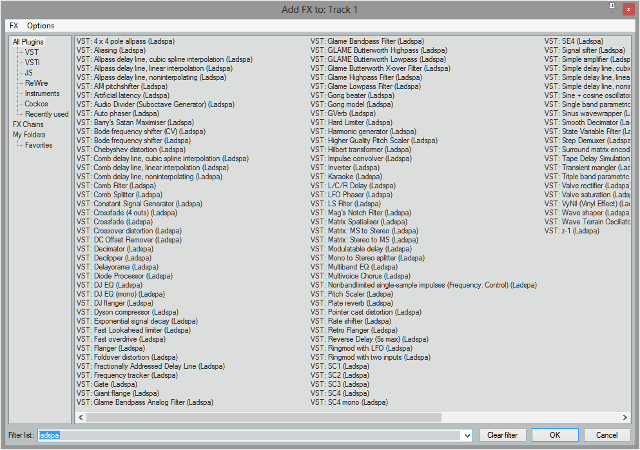
2.) Let’s start by adding an EQ effect, on the plug-ins select “VST: ReaEQ (Cockos)”.
Set the parametric EQ as follows:
Low shelf (1-Enabled)
Frequency: 50Hz
Gain: -6dB
Bandwidth: 2.0
Band (2-Enabled)
Frequency: 2000Hz
Gain: +3dB
Bandwidth: 3
Band (3-Enabled)
Frequency: 15000Hz
Gain: +2dB
Bandwidth: 0.8Audacity vst plugins install.
Band (4-Disabled/Unchecked)
This is how your Reaper Parametric EQ would look like after implementing the above settings:
The purpose of the EQ is cut the bass parts of the vocals (not needed) and then boosts the mid-frequency presence to improve lyrics clarity. A slight high-end frequency boost is to improve the vocal ambiance and presence.
For other instruments (guitars, bass, drums), you can refer to this guide on the complete EQ settings to start when doing audio mixing.
3.) The next effect on the chain would be a compressor. Simply “Add” to add another effect on the chain. Screenshot:
Vst Plugin Chain Order Code
adding effects